
- VISION
- - INSIGHT
- - ACTION
INSTRUCTING MICROBE GENES
“Prof. Dipankar Chatterji (b.1951) is an Indian molecular biologist and an Emeritus professor in the Molecular Biophysics Unit at the Indian Institute of Science, Bangalore. He earned his BSc and MSc in chemistry from Jadavpur University and a PhD in molecular biology from IISc in 1977. After postdoctoral research in the USA, he returned to India and spent 15 years at the Centre for Cellular and Molecular Biology in Hyderabad before joining Molecular Biophysics Unit, IISc in 1999. He later chaired the same department and chaired Molecular Biology and Genetics unit of JNCASR. Prof. Chatterji is known for pioneering research on bacterial gene regulation, expression and stress responses in E. coli and Mycobacterium species. His lab has produced over 200 peer-reviewed publications, and he has mentored more than 40 doctoral students. In the scientific community, he has held leadership roles, including serving as Secretary (2010–12) and President (2013–15) of the Indian Academy of Sciences. He has been honored with prestigious awards such as the Shanti Swarup Bhatnagar Prize (1992) and the Padma Shri (2016), notably reflecting his impact in molecular biology and biophysics. ”
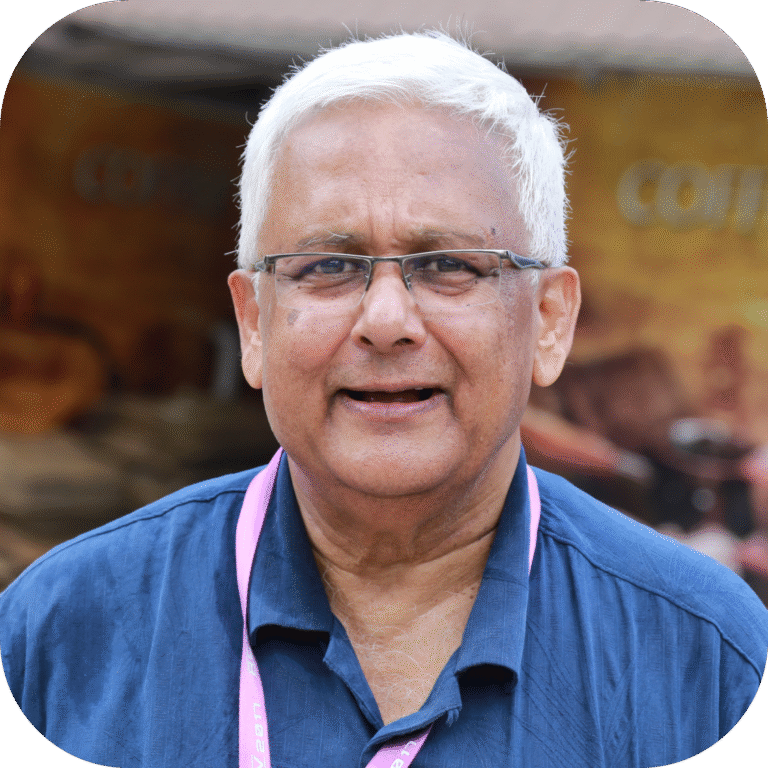
PROF. DIPANKAR CHATTERJEE
INDIAN INSTITUTE OF SCIENCE
“Nature is God, in my belief,
DNA is part of that truth”
When I was much younger, life was quite different. We had a very relaxed life, mostly spent playing, with little direction on what we should become. Education often felt like something pushed on us by teachers and parents, rather than a choice. But somehow, I found myself drawn to science. It just felt natural to me, without a second thought. Along the way, a few books and some remarkable teachers left a lasting impression and that’s how my journey in science began.
What fascinated me the most was chemistry. When I reached class 9, we had to select a stream, and naturally I picked science. I remember purchasing books and diving into them. I was deeply impressed by the clarity of definitions of solutions, matter, and materials. I was also interested in discussions on the properties of solids, liquids, gases, and principles like Charles’s law. That was the beginning of my journey in science. I liked experimental part very much and was fortunate to have some truly excellent teachers who nurtured that interest.
THE GREAT SHIFT
Then how did I move from chemistry to biology? That was quite a thought and shift. During my MSc in organic chemistry at Jadavpur University (Kolkata), a professor who had recently returned from Columbia University (USA) introduced us to nucleic acids and the DNA double helix. At that time, I knew nothing about DNA, and was fascinated by what I just learned. I even managed to answer few questions well in one of the exams. Still, I wasn’t entirely sure I wanted to pursue biology then, even though the idea of DNA stayed with me.
Fast forward, then came the interview for PhD. Things were very different back then, there wasn’t the kind of pressure you all face today! We simply bought a ticket, went for the interview and that was it. Going abroad wasn’t an option for me at
the time, because I didn’t have the financial resources for it. When I reached Bangalore, they asked me what I wanted to work on. I said “DNA!” They asked, “Do you know how big DNA is?” I said ‘very big’. They asked for the actual size, and I gave an awfully bad number. They started laughing, but somehow, they still admitted me.
At IISC Bangalore, I was fortunate to have excellent professors and a strong coursework. That’s how it started. So, that brought me into the field, and I stayed with it for rest of my life. It has been a fulfilling, meaningful and esteemed journey. If there is anything I believe in as God, it is the DNA double helix, a continuous flow, like a river. Once it is created, it goes on, it never dies. It keeps moving, changing, and mutating, but it never stops. To me, it possesses an extraordinary quality, just as all of science and humanity do. Even our emotions are rooted in the foundation of the DNA double helix. In my opinion, Nature is God, in my belief, DNA is part of that truth.
PATH OF DNA
I joined IISc in 1973 for my PhD. Within a year, there was a meeting for the 50 years celebration of Bose statistics in 1974 where all the leading Indian physicists had gathered. I knew nothing about physics, but the way they presented, spoke, lectured, and asked questions amazed me. Then, after some time, I was on campus, and I heard E. C. G. Sudarshan. He came from abroad to deliver a lecture. With that energy and enthusiasm, you feel that the only thing you want to do in your life is science. That environment, created by the people of institutions like IITs and IISc, was truly transformative.
MY WAY OF CONTRIBUTION TO SOCIETY
It is never easy to facilitate science in a complex nation. As a professor or department chair, or as the President of the Indian Academy of Sciences, the challenges everyday are new and never heard of. One day, the then Director of IISc invited me to join a program called ‘KVPY’. I ran KVPY (Kishor Vaigyanik Prosthana Yojona) for 20 years, as chairman. The main goal was to select brightest students from schools for science program of the nation. It remains the most satisfying contribution of my career, channelizing outstanding students. Although some criticized the program as elitist for selecting only 100 students from across the country, I believe the students we chose were exceptional. They stood out for their brilliance.
Traveling all over the country for interviews and to prepare question papers was the part of the job. I think it’s a record, not once was a question leaked for a national level exam. We used to be at same place where IIT’s question papers were printed. Nobody knows about the existence of that place, yet the person makes a lot of money and is highly selective and secretive.
I will never forget one instance of the KVPY interview. I was going to Kolkata from Bangalore for the selection, and I was thinking about what questions to ask. Asking just (𝑎 +𝑏)2 isn’t finding out the real depth of a person. I was reading Nature magazine on the flight. Nature discussed certain books that changed lives and concepts, bringing about a paradigm shift. A paradigm shift is when you start viewing things in a completely different way. So, I thought we should ask about books. To my astonishment, there was a student we interviewed for more than one hour. He was doing so well, and answered every question. I then asked him to name three books in physics, chemistry, and mathematics that changed his paradigm. He paused for a moment and then said: for physics, The Feynman Lectures; for chemistry, Linus Pauling’s The Nature of the Chemical Bond; and for mathematics, he mentioned another significant work, which I was not aware of. I said, “wow, you read all these?” He said he had read all of them, and he was right on the mark. Then I asked about biology, what book changed his way of thinking? “Origin of Life”, was the answer. So, I said, you have to select this guy, you cannot say no to him. Fortunately, he got selected! He started studying in Kolkata.
Unfortunately, in his second year of BSc, a team of ambitious Americans came to India spotted him and offered a summer program. They sponsored him, at the MIT, for two consecutive summers during his BSc. Afterward, they supported him for his MS and he’s in the US now. In my opinion we lost our one most valuable mind. Right environment and necessarily right recognition of the treasure brain is need of the hour.
NATURE OR NURTURE?
Around 2011, the B.Sc. undergraduate program at IISc started. I taught the first biology course BIO-101. I found the knowledge and basic skills of the laboratory work, ‘inadequate’. So, I put a lot of effort into re-designing experiments. To remember one, I told the first-year BSc students, to pipette 1 μL, 2 μL, 5 μL, and 10 μL. Then, they were to place it on butter paper or in a cup and weigh it on a microbalance. After that, they had to plot the weight versus volume, draw a line, check if it passed through zero, and tell me the slope. They all came to a slope near 1 So, these were the first practical ones, and they enjoyed it and repeated it. They got a glimpse of what makes an experiment good and the importance of repetition and reproducibility. Teaching the first course was the most difficult period of my life. These were smart, motivated students from good families, eager to learn. At the same time, they would ask questions to put one in awkward, embarrassing situations, at times. So, they asked me questions, and sometimes I didn’t know the answer. I used to apologize and say I’d go and study and clarify the next day. They took it very nicely because I was honest. I used to give lectures based on slides, with 20 slides in total. The night before, I would send those 20 slides to every student’s email so they could review them. Then, I’d come to class the next morning. If I changed a little bit, a student would say, “You have changed this. You haven’t given this slide.” That means they studied! If I gave an assignment, they would send it to a friend studying in Europe or in the US the night before to get the answer. So, my questions became international. It was a lot of fun, but also a lot of pressure. I had many students who did their PhD from my lab. They are all over the world now, many of them are professors. Also, many MSc project students and many undergraduates.
I would say my life has always been closely intertwined with my students, I lived on with students, the lifelong time as a professor. That, I feel, is the greatest legacy I leave behind. It is more that they have given me. What more could one ask for?
UPs & DOWNs
The most motivating day of a practicing scientist’s life is when a paper gets accepted in a good journal. The best day in my life was when a paper got accepted in a very good journal. And the worst day was when a paper was rejected. Peer recognition is the most important. I edit a lot of journals now after retirement, that’s my job. I serve as an editor and associate editor for a well-known American Chemical Society journal. So, writing a rejection feels very bad. The person works so hard. Unless it is wrong, Idon’t write a rejection. I try mostly to revise the paper. Your grant may not be accepted, your thesis takes longer, your papers won’t get accepted, you have to live with it. What to do? It’s part of life. So, it is a challenge. You have to take it. Get up the next morning, brush your teeth, eat breakfast, and say, ‘No, we’ll take it up. Fight it up. Let’s do it.’ That’s the attitude.
Although some setbacks are fundamental and should be addressed as soon as possible, I did see a major setback in terms of scientific progress. The policies to increase funding for scientific research never came through. The percentage of the amount of money we get for doing science is not adequate, compared to any other country. I also feel very bad when students suffer.
MOL-BIO: HIGH STAKES
With the US being at the leadership position, molecular biology developed in the West along with England, Germany, and Japan. Our students went there, got trained, came back, and wanted to make an impact. People realized it’s a key subject to understand. Also, it has direct links to industries such as drug development, disease research, and genome studies. And we have had tremendous success in certain cases. We have people who have done international level work in biology. The subject is progressing rapidly worldwide. If I were 40 or 50 years younger and starting my career today, I would focus on research around gut microbiome. Everything these days comes back to what people call your ‘gut feeling’ and we refer to it as that. How is your health? How are your food habits? Your emotions, your pain, your dreams everything is connected. It’s known as the brain-gut axis. Your thoughts and mental health are influenced by the food you eat and the environment you’re in. One question I often think about is this: people say the first six months after birth shape your future. Are there early genetic changes that make the environment play a key role in shaping a person’s life so quickly? How can you predict personalized medicine? Can you say, “These are the medicines one should take; or should not”? At the age of 20, I don’t want to know that at the age of 55, I will have a major issue that will spoil my life. That’s how it is. So, these will be the most interesting questions that we will see answered in the near future.
One practicing scientist should know that they cannot fool all the people all the time. You can fool some people all the time, all people some time, but not all people all the time. I believe India has great potential with the talented students entering our systems. There is no reason why they will fail because they have very good students. I taught them, I know how good they are.
BEYOND LABS
During COVID, the vaccine was developed successfully in our country. Pune’s institute did an excellent job. This lab and Kiran Mazumdar-Shaw in Bangalore also made important contributions. Many dedicated people were involved. Look at India after independence. If you read the history of science, you can see what achievements we had. Today, India is the highest milk production country in the world. That’s because of one person, Verghese Kurian. Today, India produces more rice than even China, and we were a starving nation. We used to have the PL480 scheme in the 60s. Today, we are exporting rice due to the Green Revolution, M.S. Swaminathan. What Cyrus Poonawalla has done for the vaccine during COVID is a remarkable job. India is a very good pharmaceutical market. Everyone comes to India for pharmaceutical medicines, where we’ve had great success. I’m sure more achievements like that will follow. But when it comes to fundamental research, I’m still unsure how far we’ll be able to go. We should be more innovative. Some people have done it, but we are still a little far away.
I think soon startups ecosystem will focus on designing molecules to regulate gene expression. One would like to control protein production at specific times. This can be really helpful to treat diseases caused by protein deficiencies. This can be done using small molecules that target DNA sequences to control protein expression. This will be the starter. You can design a molecule, and AI can predict if it’s a good starting point for a drug. Similar concept can be used for vaccine design.
A good small contribution might change into a big thing; you never know. It always happens that way. Government support is crucial, and scientists and advisors must communicate its importance. Often, it’s the fault of the scientists that they cannot clearly define why they need money or why they need support. We need to engage with the public and open minded leaders. Explaining to them what’s missing and how their support can help bring change. I believe more people should not only pursue science but also get involved in science policy. As a result, later collaboration between academia and industry will bound to grow. Academics should engage more with industry, and industry should actively support these collaborations.
Date 04.01.2026
Molecular biology, Molecular regulation, Gene expression, Predictive AI, Industry-academia collaboration